Posts

BYZANTINE ART – MIDDLE AGE

Image
          The Byzantine Empire, also referred to as the Eastern Roman Empire, was the continuation of the Roman Empire in the East during Late Antiquity and the Middle Ages, when its capital city was Constantinople (modern-day Istanbul). It survived the fragmentation and fall of the Western Roman Empire in the 5th century AD and continued to exist for an additional thousand years until it fell to the Ottoman Turks in 1453. Byzantine Empire was a continuation of the Roman Empire but the majority of modern-day Italy was overtaken by barbarian tribes. Citizens of Byzantine Empire continued to refer to their empire as the Roman Empire or Romania and to themselves as "Romans”. There are three significant periods in Byzantine Empire which is Early Byzantine, Middle Byzantine and Late Byzantine. Crossbow fibula 430 CE             Fibulae are brooches that were made popular by Roman military campaigns. They all consist of a b...

ROMAN ART – EARLY EMPIRE

Image
          Ancient Rome refers to the Roman civilization from the founding of the city of Rome by Romulus in 753 BCE to the collapse of the Western Roman Empire in 476 CE. Ancient Rome encompasses the Roman Kingdom, Roman Republic and Roman Empire until the fall of the western empire. In 509 BCE, Rome became a republic but collapsed in a civil war thus triggered the beginning of a new period. Roman Empire began in 31 BCE when Octavian, the adopted son of Julius Caesar, defeated Cleopatra and Mark Antony at the Battle of Actium and was granted overarching power and the new title ‘Augustus’. The imperial period of Rome lasted approximately 1,500 years compared to the 500 years of the Republican era. The Roman Empire was among the most powerful economic, cultural, political and military forces in the world of its time. It was one of the largest empires in world history.           When you think of Roman art, the Colosseum and the ruins ...

EARLY BUDDHIST ART – ANICONIC PHASE

Image
          Buddhist art includes sculptures, paintings and other art forms that represent the stories and concepts of Buddhism. The earliest Buddhist art, which originated in India, was mostly symbolic and avoided figurative depictions of the Buddha. Later, as Buddhism developed and spread to a variety of cultures, its religous art came to represent the Buddha, boddhisatvas, and gods in rich figurative imagery. Ritual art, such as the intricate mandalas used in meditation, is also an important aspect of Buddhist art.           The Aniconic Phase of Buddhist Art took part in between the 5 th  century and 1st century BCE. The first clear manifestations of Buddhist art date back to the time of the emperor Ashoka during the Mauryan era (322-180 BCE), through the building of numerous stupas, such as the one at Sanchi, and the erection of pillars. The pillars were surmounted by animal capitals and decorated with Buddhist symbols. Alth...

GREEK ART – HELLENISTIC AGE

Image
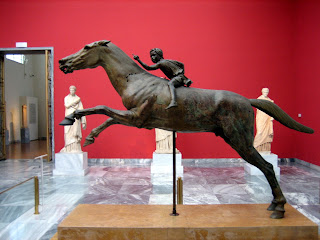
          Ancient Greece was a civilization that existed in between around 12 th -9 th centuries BC and around 600 CE. The civilization can be divided into several periods; Greek Dark Ages, Archaic Greece, Classical Greece and Hellenistic Greece. The Hellenistic Age begins in 323 BCE with the death of Alexander the Great and ends with the battle of Actio in 31 BC. The Hellenistic Age marks the transformation of Greek society from the localized and introverted city-states to an open, cosmopolitan, and at times exuberant culture that permeated the entire eastern Mediterranean, and Southwest Asia.           During the Hellenistic period, art underwent dramatic transformations and evolved on the road paved previously by the Classical artist. While the Classical Greek concepts were not entirely abandoned, the artists of the Hellenistic era expanded their formal horizons with dramatic posing, sweeping lines, and high contrast of light, s...

CHINESE ART – HAN DYNASTY

Image
            Among China’s major dynasties, Han Dynasty was one of the longest of all. It was between 206 BCE and 220 CE and considered as the Golden Age in Chinese history as there were only minor interruptions during the period and lasted a span of over four centuries. Han Dynasty was founded by Liu Bang or known as Emperor Gaozu, who became the first Han emperor after the collapse of the previous dynasty (Qin Dynasty). It was noted in history that Liu Bang was the first Chinese emperor who was originally a commoner. There are a few notable contribution of Han Dynasty towards the modern days; the opening of the Silk Road and the great appreciation of Confucius. Although Han Dynasty ended in 220 CE, it is clear that the Han still lives on today and even Chinese people refer to themselves as the Han people. Wu Liang Shrine 151 CE - 168 CE              Creating permanent artworks in durable materials was a ...

EGYPTIAN ART – NEW KINGDOM

Image
           Ancient Egypt was a stable kingdom, in which several periods of relative instability came between it. New Kingdom of Ancient Egypt came after the disunity of the civilization called the Second Intermediate Period and followed by the Third Intermediate Period where the central government of the civilization was dissolved. New Kingdom was the most thriving time of Egypt, dated between 1570 – 1069 BCE. This kingdom, covering the 18 th , 19 th and 20 th Dynasties of Egypt, is the era that was completely documented and gives a great understanding of Ancient Egyptian history. It was during this period that the rulers being called ‘pharaoh’ and a few well-known New Kingdom’s pharaohs were Hatshepsut, Akhenaten, Tutankhamun, Ramesses II and Ramesses III. Golden Death Mask of Tutankhamun Valley of the Kings, Egypt 1332 – 1323 BCE (sovereign)                 Tutankhamun is the most popular phara...

PREHISTORIC ART – PALEOLITHIC PERIOD

Image
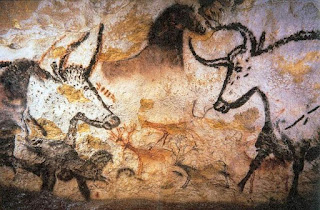
Paleolithic period, also known as the Stone Age, is the time when stone tools began to develop. This period began at about 2.5 million years ago but ended at different times in  different parts of the world, generally around 10,000 years ago. Discoveries of arts from this period, however, dated only up to around 40,000 years ago. Most of the arts found are from the Upper Paleolithic period. The ones responsible for the artworks of this period are the European early modern humans. Thus, Upper Paleolithic period can be simply as the time where Homo sapiens were rising along with their mastery of tools and weapons creations.   Hall of Bulls Lascaux Cave, France 16,000 – 14,000 BCE         Lascaux is located in  Southern France and was discovered in 1940. The above picture, the Hall of Bulls, is only one part of the wall in the Lascaux Cave. The Hall of Bulls is a painting dated up to 16,000 BCE, the Late...